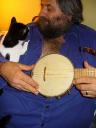
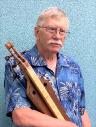
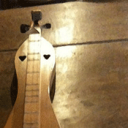
How many dulcimers does one need?
Easy: just one more! 
Since I don't like to tune my strings more than one step north or south of home base, I keep instruments set-up for specific home base tunings. For example, from the home base DAA (1-5-5), I'll re-tune to EAA (1-4-4) for the key of A or DGG (1-4-4) for the key of G.
-Prussia Valley Music Box is tuned ddd. You'll often hear this unison tuning referred to as Galax tuning. With the 6.5 fret on this instrument, in this tuning one can play out of D and G without re-tuning. And to get a more haunting sound, I'll use a false nut under the drone strings at the first fret to raise the drones to E.
-Rod Hensley hourglass is tuned Ddd. You'll often hear this 1-8-8 tuning referred to as Bagpipe tuning. This instrument also has a 6.5 fret so one can play out of D and G without re-tuning. As with the PVMB, I'll use a false nut under the drone strings at the first fret to raise the drones to Ee.
-And the other 5 dulcimers, 4 of which are purely diatonic (no "extra frets"), are set-up for some 1-5-5 home base tuning.
I did take a chance one time one a young guy that built one for his self and then sold it to buy another instrument. It was a 6 string and I wanted one. I got it for just 120 dollars and it played and sounded great. But it could have just as easily been a dud. I usually don't buy from anyone that says no returns. I don't spend real big money on a dulcimer I can't see or play.
Well Barbara, I lucky in that I live really close to Warren Mays shop and I own 3 of his dulcimers. I go to festivals, where I bought my Papaws dulcimer and my Modern Mountain. I bought my banjammer from Clemmer so I knew it would sound good. My Homer Ledfords I bought all three off the internet but Homer made wonderful instruments so I knew I couldn't go wrong. I have only bought one through ebay that was total JUNK and I sent it back to the seller telling them so. They totally misrepresented it on purpose to which made it even worse. They relisted it still saying what a wonderful, great sounding instrument it was. LOL It couldn't even be tuned because of the way it was made. I just have learned what to look for in a dulcimer and I don't buy from builders that I don't know without playing them first. I know most of the builders that I have dulcimers from.
Well I say there like Lays potato chips, no one can have just one. Or at least I can't have just one. I am addictied to collecting dulcimer. I have 13 at the moment, and most of them are tuned dad. I don't have a prop. retuning as I play. Oh 2 are baritones and are tuned AEA and one of those is the one I play more than any here at home. When I play with the group I play one of the others. I have 3 Homer Ledfords that are the pride of my collection and if I find another for the right price it will join them. I have dulcimers hung up all over my walls. I just love them and can't help my self. But I have found out over the time is not to buy because they are pretty, buy them for there voice. Sometimes the ugliest dulcimer can sing the prettiest.
Well, well, how many indeed? I have 2 3 strings tuned DAd, neither of which has any 1/2 frets. I have 2 with 4 equidistant strings one tuned DAAd one tuned DADD. I have a 3 string and 4 string with paired melody string tuned DAA. I have a 5 string which I had in Jim Good's tuning bDGGG but which is now tuned dDAdd (both the bass and melody are paired.) And lastly the Heatherwood is in DAdd but with geared tuners it gets changed to DGdd or DAcc or DGcc (again paired melody string.) When I finish fixing up the other 3 we'll see what tunings they want to be in. The one in my avatar will not sound correct if tuned to DAd and the other one tuned DAA came that way with heavier strings on it, so I just left it like that. I'll be using it on one of my next videos, I hope. Oh and the Capritarus is CGcc (again paired melody string.) I don't like to retune to DAA from DAD. I use heavier strings on the ones tuned to DAA and lighter strings on the ones tuned DAd. The Capritarus just sounded better in C tuning to my ear. I may change the Mastertone 5 string to DGd. In fact I'm going to do that now. So many of mine have pegs instead of gears, it just makes it easier.
Oh and I played for over 20 years and had only one. These others have been acquired in the last year.
Rob
Changing to a lighter gauge string will make it easier to press, but are you sure that is the issue? If the action is too high, you should first have the action adjusted. Second, determine what tunings you expect to use. Changing string gauges has an effect on what tunings you can use. If you use multiple tunings, you may find you cannot lower the lighter strings as far before they get too loose to sound clear. Strings are cheap enough and easy enough to change back, but determine what tunings you plan to use first.
Paul
Remember Klaus, this is NOT a guitar you're fingerpicking. It's not going to feel the same. You can certainly change the strings a gauge or so in either direction, but the optimum gauge is dictated by the note you are tuning that string to, not how you play that string. If you go too far outside the range, the string will be too floppy and buzz , or much too stiff and risk breakage.
BTW - 12, 12, 12, 22 is not obviously for DAA. I've played DAD using 12, 12, 14, 24 of decades. And I have a 3-string that uses 11,11 and 18 plain. 
If you go to the Groups area and ask this question in the Fingerpicking Group, you might get more answers.
Nancy - that's certainly sounds like one of those "stick instruments" which I've taken to calling American Citterns as it is more descriptive of what they are. If it has a neck, it's NOT a dulcimer, by international definition, no matter what people may say. Calling a lump of coal a diamond in the rough does not make it so...
"Banjammer" is one of several names for a banjo/dulcimer hybrid which usually involve a small tambourine or other drum with a 'skin' head embedded in the middle of a regular dulcimer body.
Cindi - if you read my post of page 2 of this thread, you'll see that VSL, shape, number of frets or number and size of soundholes among other things are not part of the definition of a dulcimer. It is a fretted zither (strings across the top of the soundbox) with no neck, but with a body-centerline fretboard. Stick instruments have necks, therefore by definition they are not dulcimers.
Cindi, The VSL of an instrument has nothing to do with whether it falls into the dulcimer category by way of definition. Dulcimers I've known and owned have ranged from 30" VSL to 17". And Don Neuhauser sells a baby dulcimer that fits in a Crown Royale bag. Cute little thing and notes correctly, just very high.
Now with a guitar, if you played it on your lap and slapped a wooden box or some other type of box to the neck, the number of strings or how it was fretted wouldn't matter, the thing would become a zither. 8-)
The walkabouts were each named by their makers. They seem to use common dulcimer tunings, and a lot of them are diatonic, using the same or similar fret patterns as diatonic dulcimers. This may be where the dulcimer related names came from. How the scientists categorize it is based in whatever historical and other info scientists use for such decisions. The mountain dulcimer isn't really a dulcimer, but a zither, so how can the walking stuff be dulcimers? Only a hammered dulcimer is a dulcimer, right? Or is it a Cymbalom? Did I spell that correctly? Spell check doesn't know.
Paul
Some time ago in Everything Dulcimer I started a discussion asking for all the variuos names used for what we call the mountain or Appalachian or lap dulcimer. Rather than search that discussion out and add a link, I've just attached a Word version of the final list. I thought you might find it fun.
Hi Barbara,
The traditional mountain dulcimer was not known as a mountain dulcimer or Appalachian dulcimer - these are fairly recent terms. The instrument went under many different names in many different counties (waterswivel, fence scorpion, hog fiddle, dulcimore, music box American dulcimer etc etc). The shape of the body varied, hourglass, boat and teardrop all being made in different areas around the same time. The number of strings varied in differnt regions as did the tunings. What was consistant was the fretboard not extending beyond the body, the diatonic fret layout and frets under the melody string(s) only. So it was always played in a melody over drone style, andin most counties with a noter.
So that defines a moutnain dulcimer..er..hog fiddle..er..scantlin...er...feather harp...er...dulcerine..er.. Well, you get the idea!
For me, it is the diatonic fretboard, melody string only fretting and playing over drones that defines the instrument in its traditional form.
In terms of its contemporary form - well the sky is the limit !!!!!!
By organological (science of musical instruments) definition, the dulcimer belongs to a class of instruments called Fretted Zithers.
The body shape, number or arrangement of frets is not part of the definition of Fretted Zithers in general, but can define variations in type. Baltic Psalteries like the Kantele vs southern European Plucked Psalteries for example. Location of the frets (central to the body as in the Dulcimer vs on the near edge top as in the Hummel) is another example. Dulcimer tradition calls for 3 courses of strings, each course can be single, double or even triple stringed.
All Zithers (fretted or not) have their strings running across the top of the sound box rather than at right angles to it as a harp does. Psalteries (plucked or bowed), Kantele, Gusli, Autoharps, Hammered Dulcimers etc. are all local/regional names for Zithers. No Zither has a neck - anything more than the tuning head extending beyond the body.
Guitars, mandolins, banjos, "stick instruments", Waldzithers, lutes, etc all belong to the Lute class of instruments. Violins, violes etc. are yet another class - necked and unfretted.
So if you take strings off of a guitar you have a guitar with fewer strings. If it has a neck it is not a zither/dulcimer, by internationally recognized definition
Barbara, I am sure you could find numerous discussions here and even more at Everything Dulcimer in which people tell those with chromatic dulcimers that they should just play guitaror those with strumsticks that they aren't real dulcimers. Feelings can get hurt and I don't think that is anyone's intention. I do not speak for the dulcimer community.(In fact, a lot of people can even tell by my playing that I am really a guitar player who switched teams.) Some people within the dulcimer community are much more strict than others about what constitutes a dulcimer. It is that debate that I don't find very helpful.
To one person a dulcimer with a chromatic fretboard can still be a dulcimer, but to someone else, a dulcimer is a diatonic instrument played in a noter/drone style. I've always thought it arbitrary that some innovations (like geared tuning pegs) can be accepted and others (like extra frets) can't.
But I think most if not all of us would agree on what a traditional dulcimer looks like and how it was played. Let's start there. Then we can explore the variations that stem from that traditonal dulcimer withough worrying about specific classifications.
Barbara P said:
Thanks Dusty Turtle. That makes perfect sense to me now. The dulcimer community accepts all similar styles as dulcimers. I'm sorry, I didn't know that this might be a sensitive subject. I guess that's why I couldn't find my answer in the archives.
I've stayed away from this conversation because, as those who've taken part in such discussions before can attest, things can get a little testy. Can a dulcimer have "extra" frets? Can you play chords on it? Can you reverse the string order and hang it over your shoulder like a guitar? If I tune my guitar DGDGBD and lay it flat on my lap, is it a guitar or a dulcimer? If a cigar box is used as the sound box, does the fretboard become a neck? Can it still be a dulcimer then?
Rather than asking "what constitutes a dulcimer" which only encourages us to draw a sharpboundary between dulcimers and other similar hybrid instruments, let's askhow to define a traditional mountain dulcimer and traditional mountain dulcimer playing, and then explore what some of the variations of that instrument and those playing traditions are.
Even the analogy of waterfowl species doesn't quite hold up. A goose may not be a duck, but if you see an odd-looking waterfowl that appears to be half goose and half duck, what is it? We define a species as a a group of animals that can produce fertile offspring. There is a species of bullfrog on the east coast whose habitat ranges from Maine to Florida. At each step of the way, the bullfrogs can mate with those around them. But if you take one from Maine and one from Florida, they cannot mate. Or let's try another analogy. Take an ice cube and put it on the counter. It immediately starts to melt. On the outside, therefore, is water, and in the very center is ice. But where is the boundary between those two? As long as it feels wet, it is water, and you can never quite get to the ice because as you get there it begins to melt.
Sometimes there are no clear boundaries and rather than inventing them to make our classification system seem more rational, we should just accept that everything is in flux. Traditions evolve. Let's embrace the old, and the new, the long accepted and the avant guarde. If the music is sweet, it's all good.
There's a system of classifying instruments that puts the dulcimer in with zithers. Zithers have a sound box that the strings completely cross. The stick type of dulcimer would be classified by this system as a lute type of instrument in which the strings cross the sound box but continue up a neck, like the cittern.
There's a nice group here dedicated to the strumstick or stick dulcimer.
I just have to say that I may have gotten into a bit of a "mixed metaphor". Holden Caulfield from J D Salinger's novel Catcher in The Rye didn't say that, but instead asked "where do the ducks go in the winter?"
It appears that Indiana poet, James Whitcomb Riley may have actually been the first to coin the phrase when he wrote "when I see a bird that walks like a duck and swims like a duck and quacks like a duck, I call that bird a duck."
This quote also seems to have been said by Theodore Roosevelt at one time and it was also used during the McCarthy trials for communism.
I have McSpadden's banjomer and it works for me. Easy to play and has a good sound and is reasonably priced. I use it mostly for Civil War tunes and Stephen Foster tunes and a few blue grass types. I have it set up just like the one David Schnaufer used from McSpadden, with a cloth inserted in the hole on the bottom.
Banjmo, banjammer, there are about as many spellings as there are people making them. All basically have a small drum head or tambourine imbedded in a dulcimer body, and diatonic fretboard that stops short of the drum so that a banjo type bridge can sit on top of the skin head. Can certainly be the perfect instrument for that special sound if you don't want to take up banjo, but don't necessarily sound great on all kinds of music.
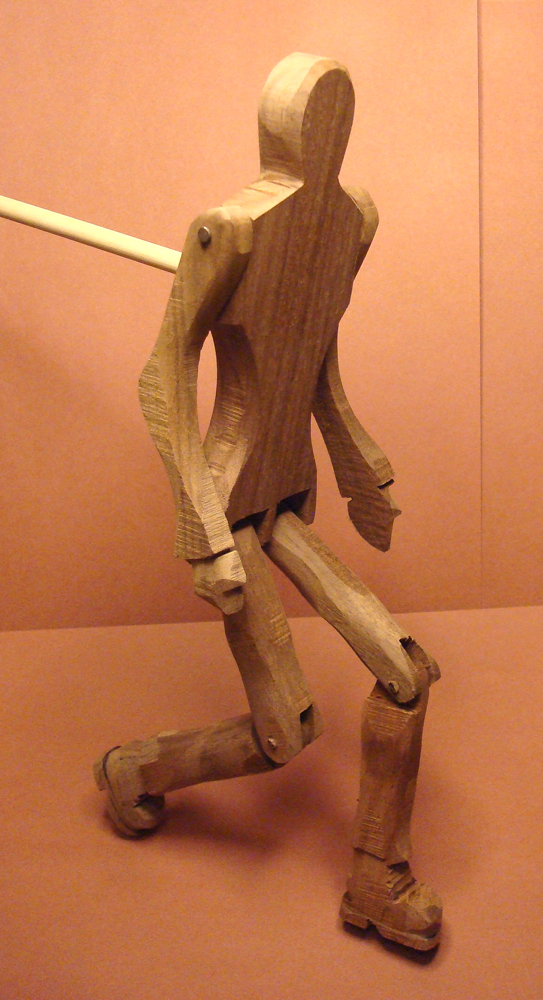
And speaking of using up small pieces of wood- Years ago when I ordered my limberjack "Clyde" from Keith, he told me he used up the leftover bits of dulcimer wood to make his limberjacks, mostly walnut pieces. He said that was why they danced so well- they were imbued with dulcimer wood spirit. 
I have at least 10 different limberjacks- both new and old, but the two Keith ones are always the best dancers!
Me, too, Dave. Those "imperfections" can give an instrument real character.
Yeah I really likeit too. Thereis a localdulcimer maker that makes his dulcimer so that thereare no imperfections in the wood, in fact he brags about it. Nice dulcimers butbecause of the type of wood he uses you can't tell one of his dulcimer from another. I really enjoy seeing the wood patterns and "imperfections" in everyones dulcimers.
Robin Thompson said:
Thanks for sharing the photos of the treasures Keith made for you, Dave! That wormy chestnut is so cool. . .
Thanks for sharing the photos of the treasures Keith made for you, Dave! That wormy chestnut is so cool. . .
Might as well add the photo of my Keith Young limberjack too. I've seen a lot of very well done limberjacks that have been painted and/or dressed up. I've always been afraid to mess it up. Do need to find a little dulcimer for him...

David, they are just lovely. I too have Keith's limberjacks- I absolutely adore them!
I was saddened tolearn about Keiths passing on the 9tha little while ago.
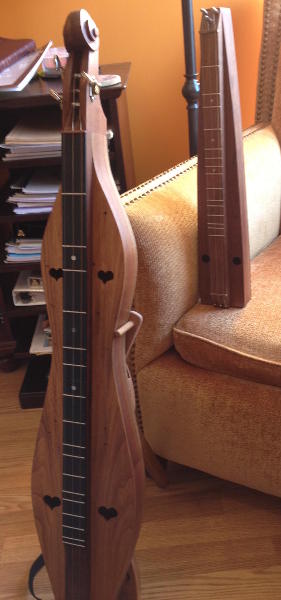
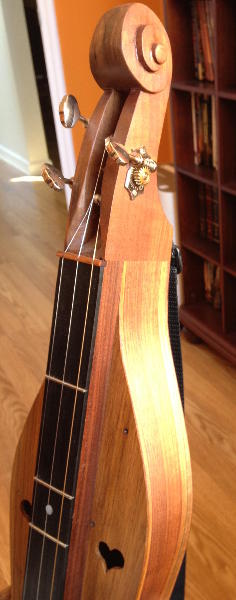
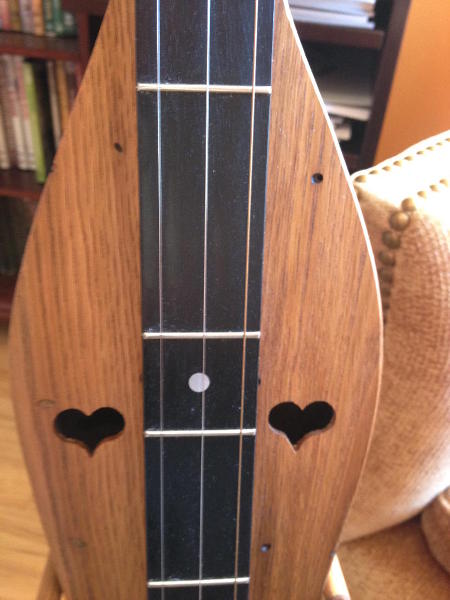
Here's my Keith Young dulcimers (I should have had my Keith Young limberjack added to the photo as well). On the full size dulcimer: Walnut side/bottom, wormy chestnut top
Just to clear up an old comment (I wasn't a member at that time and didn'tsee it), the WNCDC taband midi files areuploaded toEverythingDulcimer about once a year. I think I may be a year or so behind, besides...
But the Western North Carolina Dulcimer Collective tab page is always up to date as of the current newsletter, and also includes mp3 recordings of each tune. They're the ones we used to send out on CD, but this is easier! One version is always the melody, the second isas-shown on the tab, andoften there's a third that is either finger-picked or playedat full-speed if it's a faster tune. (No tab for the fingerpicked versions, because I make them up as I record them!) And all of our tunes can be played on just the melody string with drones or with full chords, in either D-A-dd or D-A-AA.
The midi files are on both websites, although I really wonderwhether anyone uses them. But they're so tiny and so quick to produce with the notation software I use that they're no problem to provide, too. That software, by the way, is a DOS program I bought in 1989!
Ken Hulme said:
All of the Western North Carolina Dulcimer Collective (WNCDC) tabs are archived on EverythingDulcimer.com along with midi files to listen to.
Howdy, all
I've uploaded some YouTube lessons to my channel , all of which have free tab available on my website .
I'll be doing more of this as time permits, so stay tuned.
You are welcome, Phil. That's a Blue Lion Dulcimer!
Linda
thanks Linda. Love the in-lay on the neck of the Dulcimer on your front page.